Coming Clean

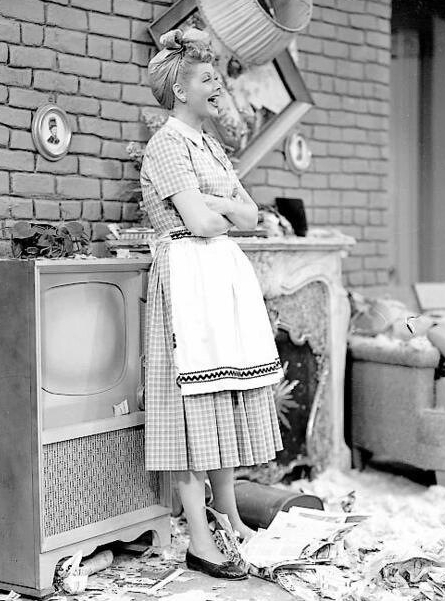
Lucy Cleaning

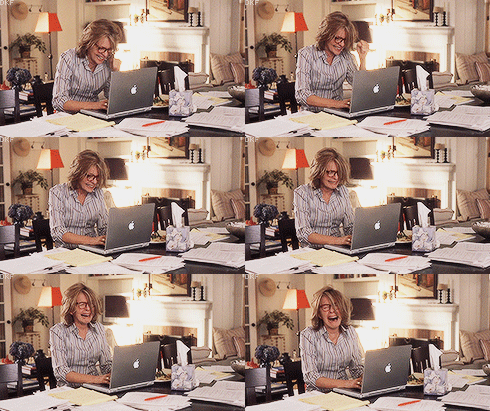
There’s a thing about cleaning and creating. It’s as if the two share the same muscle, the identical energy source. But, despite that commonality, the two can’t seem to co-exist.

I learned this when I first started writing, seriously writing. I had written two screenplays in film school and was toying with my third, now as a working woman low on the totem pole of a major production company. A woman across the hall, serving as an assistant for entertainment attorneys, was also a struggling writer. She and I would bump into each other at the elevator banks or, occasionally, in the ladies, when we would take our time washing our hands, reapplying lipstick, buying a bit more of a break before going back to work. One day, in the hallway, I had asked her how her weekend went, knowing she was going to spend it working on a script.

“Oh, you know,” she started. “The house got really clean, the dog got really clean, the car got washed, but I hardly wrote a page.”

I realized I had performed similar procrastination — which can hardly be called “procrastination” when you are productive and have proof that you weren’t idle. Look at those gleaming floors! But, the more I noticed my need to clean came just as I was about to write, I acknowledged what I was up to. It wasn’t my inner Martha coming to call. I was avoiding the work.

This is a dangerous thing for a writer. If we can come up with a legitimate reason not to write, we will. Why? Because writing is painful. The start of it, anyway. Not always, but enough of the time that we will look for reasons to avoid it. It’s not because we don’t love it. It’s because we love it so much. It’s painful because we know we will have to stop to go back to real life and waiting responsibilities. That stings. So, in order to bypass that pain, we will do something that no one can judge us for: we will clean.

Trust me when I say it’s not something we truly enjoy. Cleaning is a compromise. A quaint way to avoid. (This is one of the reasons I got myself a robot.) When we are in the story, though, we are blissed out. We want nothing to get in our way. Especially chores. And that’s the flipside of this cleaning coin. When we are deep in the writing, the home becomes something of a disaster. Clean? You must be kidding. We are using that muscle for its truer purpose — getting what’s in our brains onto the page.

The irony of this is that I can’t create surrounded by mess. So there’s the endless dance of where to put the available energy. The endless quest in any artist’s life for balance. I really want a housekeeper. But, I find the compromise. The dishes get done twice a day. The bathroom is tidied as I go. My floors are spic and span (I love my robot). But the dusting is where I fail. It goes a week or so before getting done. I know, I know. It’s embarrassing to admit. I long for a little drone to take care of that task. (Hint, hint techies.) Or a writing career that will pay for staff.

Unfortunately, I’m not quite there yet. So tomorrow, when I tackle laundry, I’ll whip out the Swiffer and dust. Right now, I have to get back to Chapter 15 with only 16 days left to finish 3 more chapters. And that leaves the rest of my life in slight disarray.
 

Pronoun Pronounced Dead

Pronoun-ebook-distribution.png

Proving that nothing good can survive in the hellhole that is 2017, I got this in my email today:

Epilogue

Two years ago Pronoun set out to create a one-of-a-kind publishing tool that truly put authors first. We believed that the power of data could be harnessed for smarter book publishing, leveling the playing field for indie authors. 

We are proud of the product we built, but even more so, we’re grateful for the community of authors that made it grow. Your feedback shaped Pronoun’s development, and together we changed the way authors connect with readers. 

Unfortunately, Pronoun’s story ends here. 

While many challenges in indie publishing remain unsolved, Macmillan is unable to continue Pronoun’s operation in its current form. Every option was considered before making the very difficult decision to end the business. 

As of today, it is no longer possible to create a new account or publish a new book. Pronoun will be winding down its distribution, with an anticipated end date of January 15, 2018. Authors will still be able to log into their accounts and manage distributed books until that time. 

For the next two months, our goal is to support your publishing needs through the holiday season and enable you to transition your books to other services. For more detail on how this will affect your books and payments, please refer to our FAQ

Thank you for the time and attention you’ve contributed to this experience. It has been a privilege to publish together, and we look forward to meeting again. #keepwriting

Sincerely,

Macmillan Publishers 

This. Just. Blows.

I was so looking forward to using this service for my next novel, and to take my other books into neglected markets. Now, the ease it provided is kaput. Back to the hard work of being an independent author and publisher.

Let’s not forget that, indie writers — we are publishers, too. No matter which platform(s) you use, you are doing the pushing to get it out there. And it’s challenging. Pronoun, by all accounts, made that much simpler. It’s sad to see something good go.

There’s still Pressbooks and Vellum to help with formatting beyond the basics, and — with any luck at all — someone will swoop in and pick up where Pronoun left off (and add a print option, too). We don’t need that to be free, just affordable.

With this sad news, I’ve made the decision to cough up the dough for Vellum. It’s not easy to do (because I’m cheap), but this is an investment in my publishing house. At $249.99, it’s not an epic amount, all things considered, but it’s also not $0, which is what you can pay if you publish the hard way. Each ebook is at least two different e-formats (Amazon and iBooks…because you do want to do both), and then there’s going to print. While I believe in keeping the overhead of a book as affordable as possible, I have also learned that having my carefully formatted passages blown out by these free conversion, I can’t afford to lose the time or remainder of my mind fixing a 300-page book. You can try Vellum for free to see if it’s right for/worth it to you (and, no, I’m not getting anything for promoting it).

I’ll be keeping an eye out for the next great thing for independent publishing. If you read the wording of the email carefully, it says “in its current form”, so maybe there will be another “form” of Pronoun down the road. But, if you stumble upon something wonderful, please share it here. It takes a village, people. Cheers!

Write, Edit, Publish

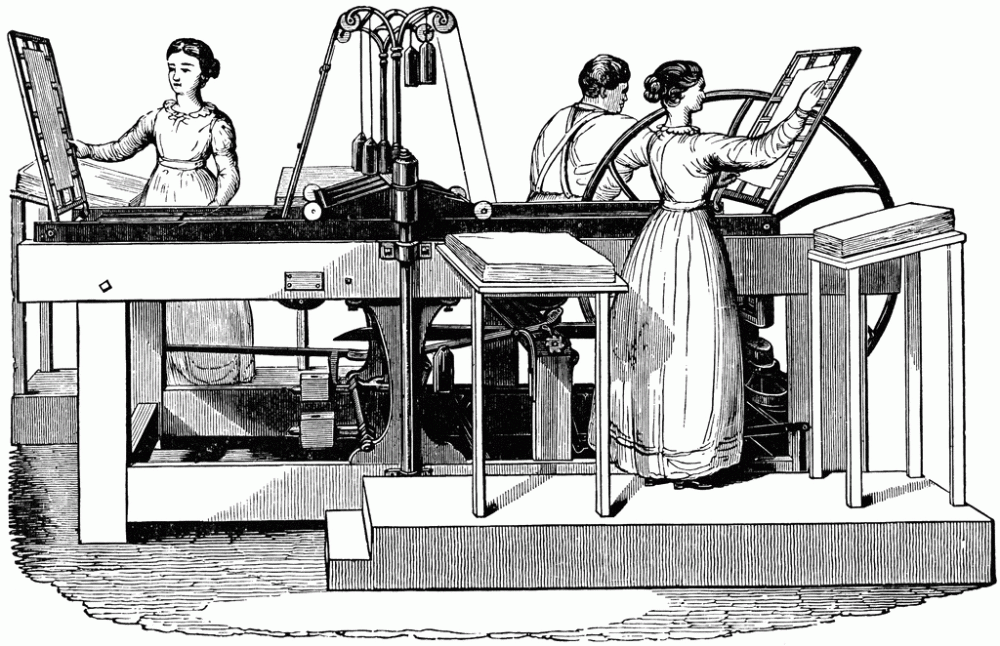
72755_platen_print_lg.gifYou’ll often hear independent authors complain that they can’t be just writers; they have to be business-minded, too. Yes, it would be nice to simply be an artist and have a team to support you. A kindly editor who could bring out your best writing. An amazing graphic artist to not only create your cover but format your book — for print and every digital platform known to man. A hawkeyed proofreader to catch every gaff. A powerhouse publicist to promote your great work. A pit bull of an attorney to go after everyone selling a bootleg copy of what you worked so hard to put out. An accountant to rake in your dough and a savvy broker to invest it in all the right places.
Alas, even if you had a book deal, that scenario doesn’t really exist but for the very best of the best-sellers.

To be honest, I’m so much of a control freak, I really don’t mind flying solo. Don’t get me wrong — I have amazing friends who step up and step in to help me with graphic design for my covers and proofreading the flaws I can no longer see. It does take a village, and sometimes that village can cost a pretty penny. Indie authors are rich in creativity, but often times broke when it comes to time and money. It’s hard to come up with the cash to pay for the help needed, or find the time (and usually money, too) to learn the software and skills to truly be DIY, and present your work in a polished and professional manner.

There are many books and blogs (hi!), and “experts” who will give (or sell) their advice on the subject. It behooves an indie author to keep abreast of what’s happening in our industry because it changes so rapidly. Let me tell you, it’s a whole other universe now compared to when I published my first book in 2006. Back then, I was a bit of an expert. Sort of a groundbreaker. I learned quickly to stay away from “vanity press” and found “the” digital printer (the company who did it for the majors), spent time and money to set it all up (all told, it was about $1200), got my book into Virgin Megastores (thanks to a friend’s connection) and then into Barnes & Nobel (because it was in Virgin Megastore). It was a lot of work done in a short time, but it was also quite exciting. In 16 weeks, I went from an idea to a published book. Next thing I knew, Cosmopolitan called. [Side note: As exciting as that was, I never saw a huge bump in sales when my book was mentioned in magazines. Sad but true. Hope your luck is better.] Back then, the world was smaller, social media was a quaint little neighborhood, and there were actually bookstores on corners. A lot of them. And they actually bought books. Even little pink ones.

Ten years later, when I published my novel, the world had changed — especially that of independent publishing. I had gone from “expert” to head-scratcher and wheels-spinner. In the time between publishing my second book (mid-2016) and my third (mid-2017), even more has changed. I started doing a great deal of market research and more “work” on the publishing and promotion side of things, which has slowed down the progress on my fourth book (my second novel that I still fantasize will be out by year’s end…don’t worry, I’m laughing, too).

There are many ways to go about this independent author thing, but here’s what I would like to recommend as of today (14 September 2017, approximately 8:00 p.m. PDT):

  • WRITE on Scrivener
  • EDIT on Word
  • PUBLISH with Pronoun

Here’s why:

Scrivener is both loved and hated (and I both love and hate it) by authors of all ilks (and a simple Google search will send you to their tribes). It has quirks and a learning curve, but it also provides some nifty tools and allows you to write on the fly — which is why I love it. You can access your Scrivener files from Dropbox and then write with your Scrivener app from your computer or iPhone or iPad…whatever you’ve got handy, as long as it’s Apple (sorry PC people). This is great when your dinner date is late or you’re doing a load of laundry and an idea strikes — just grab your phone and jot it down. You’ll never waste time in a waiting room again reading old People or playing Angry Birds. Also, it’s pretty cheap for what it offers. (If you’re anti-Apple, you may want to look into Pressbooks for similar, write-on-the-fly access and publishing ease. It’s free to use until you go to publish, then you can select your options.)

Word is something just about everyone is forced to have and, if you’re serious about writing, you’re going to need to get it. There’s really no way to work around it because the person who edits for you will want to work from it. Good editors/proofreaders are a stodgy lot who love tradition and hate change, which is why we adore them. Once you have done your own edits and polish (you really, really want to do this before sending out your work), export your Scrivener manuscript to Word and send it to your proofreader for a Track Changes edit. Accept or reject what you get back, and then you’re ready to publish.

Pronoun is getting really great reviews, so I will be publishing my next novel on it, and will also be using it to put my other books into the many markets they aren’t in currently (hello, Nook and B&N). Pronoun is free (that’s right) and is a subsidiary of MacMillan (that’s right). If your book does well enough, you just might catch the attention of a major and end up with that dreamed-of book deal and a super squadron of support. Or, you just might have an easier time formatting for digital and print, and getting your book out there to as many markets as you can in one simple step. Which is what’s most important (to me).

Of course, tomorrow there might be another wonderful platform announced, and well…

But, no matter what you choose to use, you need to stop reading right now and start writing. Seriously. Get to it.